For the second time in three years, C# has been named Programming Language of the Year by the TIOBE Index. What contributed to this achievement? The largest year-over-year growth in the ranking!
Over the years, C# has undergone a massive evolution. As a language, it has often stayed ahead of programming trends, while also going through two major paradigm shifts: from being Windows-only to becoming cross-platform, and from proprietary Microsoft ownership to open source. It can be said that C# is evolving at exactly the right moment.
Battle of the Giants: Java vs C#
For a long time, a rivalry has existed between Java and C# for dominance in the world of business software. For years, it seemed that Java would eventually win—but nothing is settled yet. The question remains: can Java, with its verbose style and Oracle ownership, stop C#? For now, there is no clear answer.
The Most Interesting Shifts in the Top 10 of 2025
The year 2025 brought several surprises at the top of the ranking: C and C++ swapped places. Although C++ is evolving faster than ever, its more radical changes—such as modules—have not yet been widely adopted. C, on the other hand, remains simple, fast, and ideal for small embedded systems, where even Rust struggled, despite reaching a record 13th position.
Other Winners and Losers
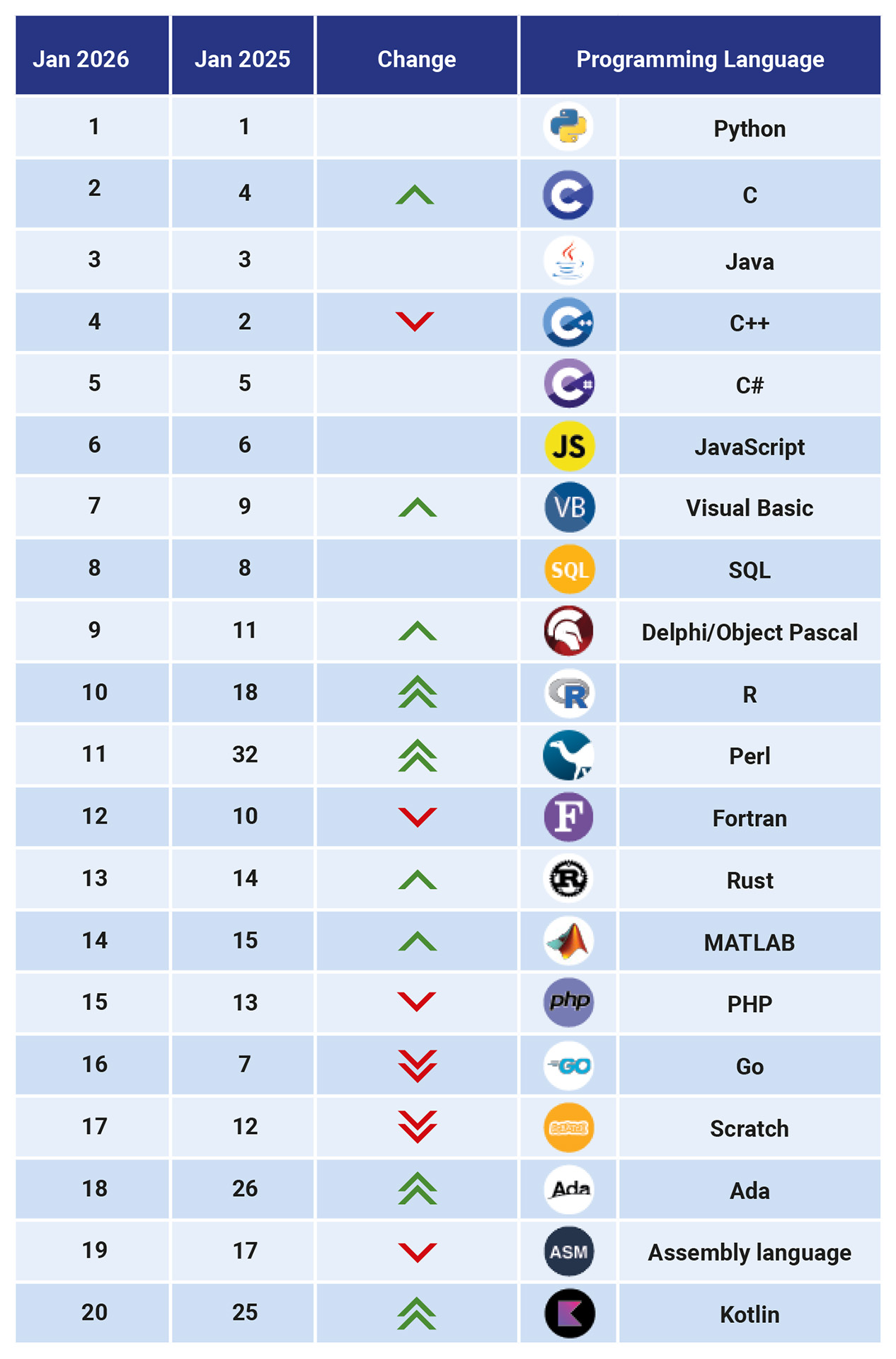
C# was not the only success story. Perl made a comeback, jumping from #32 to #11 and re-entering the Top 20. R also returned to the Top 10, driven by its growing importance in data science and statistical computing.
But where there are winners, there are also losers. Go permanently dropped out of the Top 10, while Ruby fell out of the Top 20 and is unlikely to return anytime soon.
What Awaits Us in 2026?
The January 2026 programming language ranking shows that the technology market remains both stable and dynamic. On one hand, clear leaders continue to hold their positions year after year; on the other, there are significant reshuffles in the middle and lower parts of the ranking, reflecting changing business needs, the growth of AI, and the increasing importance of analytics and legacy systems.
Python Still at the Top
Python once again claims first place, reaching a 22.61% share. Despite a slight decline compared to January 2025, its position remains unchallenged. This is due to its strong presence in areas such as artificial intelligence, data science, automation, testing, and rapid prototyping. Python not only remains popular among developers but is increasingly becoming a “common language” for both technical and business teams.
The Great Comeback of C
The biggest winner of this ranking is the C language, which jumped from fourth to second place, recording a growth of as much as 2.13 percentage points. This clearly signals a renewed interest in low-level programming, particularly in the context of embedded systems, performance, IoT, and infrastructure solutions. At the same time, C overtook both Java and C++, which recorded declines and swapped positions compared to the previous year.
Java and C++ – Stabilization in Corporate Foundations
Java, despite maintaining a strong third position, lost more than 1.4 percentage points. A similar trend can be seen with C++, which fell to fourth place. This does not signal the decline of these technologies, but rather stabilization—both languages remain the backbone of large corporate systems, although growing competition and architectural changes are affecting their relative positions in popularity rankings.
C# and JavaScript – Trends in the Enterprise Ecosystem
C# deserves special attention. While holding fifth place, it recorded one of the highest growth rates in the entire ranking (+2.94%). This confirms the growing role of the .NET ecosystem, especially in enterprise solutions, cloud applications, and business systems.
JavaScript, although still present near the top, recorded a decline and remains in sixth place. This may indicate front-end market saturation and increasing diversification of technologies used in modern applications.
The Return of Niche Languages and Legacy Systems
In the middle of the ranking, we see the return and stabilization of languages that were long considered niche or declining. Visual Basic, Delphi/Object Pascal, and Fortran maintain solid positions, showing how important legacy systems and long-lived industrial, financial, and administrative solutions still are.
Notable growth was also recorded by R, Perl, and Ada. R is gaining importance in data analysis and statistics, while Perl and Ada are regaining favor in specialized use cases where stability, security, and specific technical requirements are crucial.
Rust continues its slow but steady growth, strengthening its position as a future-oriented language for secure and high-performance system software. Meanwhile, Go and Kotlin—despite their popularity in specific ecosystems—recorded more moderate results.
Summary: The Market Evolves, It Does Not Revolutionize
In summary, the January 2026 ranking shows that the programming language market is not undergoing rapid revolutions, but rather evolving in response to real business needs, the growth of AI and cloud computing, and the maintenance of existing systems. Python’s dominance, the resurgence of C, and the stability of enterprise technologies clearly show that pragmatism and usefulness remain the key factors determining the popularity of programming languages.
What changes do you predict in 2026? Will C# maintain its strong position, or will new players fight their way into the top ranks? Share your opinions in the comments—we’d love to hear your forecasts!