Generative AI is becoming the market standard in software development. Tools such as GitHub Copilot, GitLab Duo and Claude Code make it possible to write code faster than ever before. Yet the speed of generating lines of code does not automatically translate into delivering value to customers faster. At Comarch, we decided to tackle this challenge at its very foundations. See how, through Project Darwin – an evolutionary transformation of our SDLC – we are bringing order to the development environments of thousands of engineers.
Why doesn’t AI in programming speed up software delivery?
Bringing artificial intelligence into developers’ daily work has led to an exponential increase in the amount of code being written. But when it meets a fragmented development environment, an obstacle appears immediately: the sudden influx of code hits bottlenecks such as missing automated tests, scattered repositories and inconsistent quality gates.
As a result, the time saved by having AI write code gets stuck in manual reviews, security checks and complicated deployments.
When we analyzed this process at Comarch, it turned out that artificial intelligence hadn’t created any new problems. It had simply exposed, with enormous force, the bottlenecks the IT industry has been struggling with for years. Instead of adding yet more AI tools to a disorganized environment, we decided to rebuild the foundations of our SDLC (Software Development Life Cycle) infrastructure.
– says Kamil Migacz, Enterprise Technology Officer, Comarch
The starting point: 5 ecosystems, TFS, SVN and fragmented CI/CD
A detailed inventory carried out by Comarch’s STO (Sector Technology Office) team, led by Kamil Migacz, revealed significant technological fragmentation:
- Development teams were using 5 different ecosystems for code management and automation at the same time.
- These included a veteran TFS (Team Foundation Server) instance dating back to 2008 in some projects, legacy SVN installations (Subversion, an older version control system), three separate local GitLab CE instances and a central GitLab server.
- Each product and team built its own non-standardized CI/CD (continuous integration and delivery) scripts.
The three pillars of Project Darwin and a modern “Golden Path”
The name of the initiative, Project Darwin, refers to deliberate evolution.
At Comarch, we avoid sudden revolutions that turn engineers’ daily work upside down. We rely on natural selection: the practices and architectures that adapt best to the new standard will survive.
– notes Łukasz Sabiniok, Cloud/DevOps Architect at Comarch
The transformation rests on three pillars:
- A unified process: One global, transparent SDLC standard, from commit to deployment.
- A consistent platform: Centralizing the work of the entire sector (including ERP) around GitLab SaaS.
- A standardized pipeline: An automated CI/CD quality gate built into every application, with deployments carried out using a GitOps model with Argo CD and Kargo.
What is a Golden Path and how does it work in practice?
A Golden Path is a standardized, organization-supported route from writing code to deploying it to production. The concept was popularized by Spotify. Instead of every team building its own process, the organization provides a ready-made path that is simply the easiest one to follow. At Comarch, it also has a management mandate and is the target standard.
Migrating to GitLab SaaS: what we moved and what we archived
Migrating more than 2,100 projects to a single GitLab SaaS instance required clear rules.
- What survives: Active source code, full change history, contractual requirements and related work items.
- What we freeze: Decade-old inactive TFS backlogs, outdated customizations and local YAML scripts written ad hoc by individuals.
For many teams, the biggest relief was abandoning archaic configurations and clearing out technical debt. If a piece of client code hasn’t been touched in years, there’s no point in forcing it into the new infrastructure – it went into safe “cold storage,” and we focus on active products. The migration also gave us room to reflect on whether processes should be recreated one-to-one in the new tools, or whether we should use the capabilities of the new stack to modernize and improve them.
– explains Łukasz Sabiniok, Cloud/DevOps Architect at Comarch
AI agents and humans on equal terms in code review
Bringing order at such a massive scale would not have been possible without the right organizational structure. The Sector Technology Office is responsible for delivering global components and setting the architecture, with a clear management mandate. At the same time, the STO surfaces and promotes solutions that teams were already doing well, creating space for sharing good practices and knowledge between them. It is supported by DevOps Champions – experts who promote good practices directly within business units – and by Migration Coordinators. This dedicated role was created to take the load off engineers: coordinators connect product teams with the STO, automate project mapping and ensure repositories are moved smoothly without disrupting ongoing sprints.
The new structure also introduced clear rules for how engineers work with artificial intelligence: AI agents code according to rules defined by the Comarch ERP team.
Whether a Merge Request is opened by a human or generated by an AI agent, the code goes through exactly the same security scans and automated tests. The built-in GitLab Duo assistant helps developers describe changes and handles the first stage of code review, and thanks to GitLab Orbit and the MCP protocol (Model Context Protocol, an open standard for connecting AI models with tools and data – ed.), everyone works with the same complete architectural context.
– notes Łukasz Sabiniok
Migration results: 2,100 projects, 600 subgroups, 25% of teams on the Golden Path
A pilot carried out in July 2026 on the Comarch ERP Optima Web product paved the way for the entire Comarch ERP team. Today, Project Darwin is backed by hard facts:
- More than 2,100 projects consolidated on a single GitLab SaaS instance.
- Nearly 600 structured subgroups created.
- A quarter of all teams already work 100% on the Golden Path.
- Access structure reorganized, with a move to a Service Accounts model for SaaS licensing.
- Systematic measurement (baseline since September 2026): we track Velocity (deployment frequency and MR closing time), Quality (number of detected vulnerabilities) and AI Share in the process.
Optima Web was the perfect testing ground – it was already operating in a spirit and to standards close to what we want to achieve with Darwin, which provided the tools to do it even faster and better. It’s a perfect illustration of the Darwinian principle of survival of the fittest – and the success of this migration sent a clear signal to the rest of the organization that the Golden Path simply works and makes developers’ everyday lives easier.
– says Kamil Migacz, Enterprise Technology Officer, Comarch
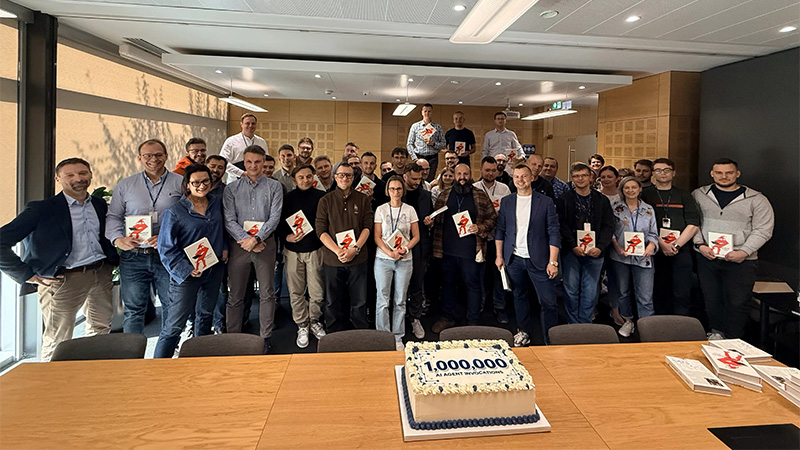
Comarch ERP team celebrating 1,000,000 AI agent invocations
3 lessons from rolling out a developer platform at scale
Project Darwin shows that building a modern development environment takes more than buying new licenses. It requires a coherent architecture and the courage to retire technical debt:
- A clear management mandate: Standardization cannot be just a recommendation – it needs the full backing of the organization.
- Automation and unification: Replacing unique local scripts with a central catalog of CI/CD components restores developers’ comfort at work.
- Readiness for the AI-native era: By building a stable infrastructure (GitLab SaaS, Argo CD, Kargo, Orbit), we have created an environment where people and AI agents build high-quality software together.
Want to work in an environment built on mature engineering, modern CI/CD and thoughtful use of AI? Check out our current job openings for engineers: